Hodú l'Adonay ki tob; ki le'olam hasdó. Queremos agradecer a todos los que han patrocinado esta labor: los libros, taletoth, el hejal y el Sefer Toráh. Invitamos a todos los dominicanos con ascendencia judía y extranjeros en el país. Berujim haba'im.
"Mi casa será llamada casa de oración para todos los pueblos". www.bmeleazar.orgJuan Pablo Duarte y Díez, de familia sevillana y con primos en Curação. Dentro del grupo de sus amigos más cercanos: David Levy León, la familia Jessurún, la familia Curiel. ¿Qué tienen en común todos esos amigos con el padre de la patria de la Républica Dominicana? Esa pregunta se la dejo para los doctores de la historia.
Si encuentras este estudio interesante o tienes parientes con raíces banilejas, dejanos saber en los comentarios.
---
We have published the results for our recent genetic study of Bani's Matriarchs. To read the complete study click here. (You will be automatically redirected to Academia.edu)
Did you find this study helpful? Do your parents or grandparents have roots in Bani? Let us know in the comment section below!
This week. I will be focusing on obtaining 10 more saliva samples from the remaining founding families needed, namely: Herrera, Melo, Sánchez, Bernal, Soto, Carvajal, Pérez, Olivas, Aybar, Rodríguez, Enríquez, Gutierrez, León, Araújo, and Cabral. In addition to this, I will be interviewing Mr. Valera and Mr. Agramonte, Baní's historians. I hope to receive key information in uncovering the lost identity of the Banilejos.
This afternoon I visited Mr. Valera's home once again. It is always a pleasure to speak to him and listen to what he has to say. The following is a transcription of the interview:
Yehonatán: When did the first colonizers arrived to Baní?
Mr. Valera: The first colonizers arrived circa 1510. They were Spaniards from Andalusia.
Yehonatán: Did they have any special characteristics to them?
Mr. Valera: In the rural areas of Baní, the people have a particular physiognomy. We have noticed that the people from El Llano, Bocacansta, and Sombrero have similar phenotype. However, the people from Cañafistol are very different; they usually have hawk-type noses, and upper lips, like your own. My grandfather also had his lips like yours. That is an indication of Andalusian origin.
Yehonatán: Why are the physiognomies different between these two regions?
Mr. Valera: I presume that the people from Cañafistol came at a later date, whereas those from the other rural towns came from the Canary Islands.
Yehonatán: Who were the first settlers that arrived to Baní in the 16th century?
Mr. Valera: They were connected to the Colón family and the Kings of Spain. Some of the first families to arrive were the Guerrero and Báez. The Guerrero were Andalusians and the Báez were first on the Iberian peninsula, then migrated to Hispaniola via Canary Islands. However, Báez is not a last name. It was originally a Jewish name, being "Weiss", which latter became Báez.
Yehonatán: So this name was Jewish from Germany and was latinized into Báez?
Mr. Valera: Correct! The Báez family is the root of all families in Baní.
Yehonatán: When did the Canary Islanders begin to arrive?
Mr. Valera: They arrived in 1718.
Yehonatán: Which are the founding families that arrived from the Canary Islands?
Mr. Valera: Suazo, and others that have disappeared. Let me see if I remember them. Montanel, Arrocha, and Niebla. The Niebla's came from Laguna.
Yehonatán: Did the first settlers migrate as single men or with families?
Mr. Valera: No! They came with their families. We don't see any single men in the records.
Yehonatán: Is is possible that some of them were "New Christians" or so-called "Marranos?"
Mr. Valera: We here affirm that. We have a tradition the Caraballo were connected to the Guerrero family. It is said that there is a mountain here called "Caraballo Hill," where the coffee is planted. Caraballo comes from Carvalho, a Portuguese surname. They were from the Canary Islands, and were possibly Jews. We here have a tradition in Baní that we descend from Jews and that our entrepreneurial spirit comes from our background. It is also said that the wells that were dug was due to the Jews, and not Billini, who came later.
Yehonatán: Why is Matanzas called by that name?
Mr. Valera: It is called Matanzas (slaughters) because that is where the animals were sacrificed and meat was sold. Also, the skin was used to make shoes.
Yehonatán: Which of those Andalusian or Islander families practiced endogamy?
Mr. Valera: All of them!
Yehonatán: All of them?
Mr. Valera: All of them! Baní is the town with the most extensive and exact ecclesiastical records in the country, because we are all cousins.
Yehonatán: That means that my study will demonstrate a high level of endogamy in Baní.
Mr. Valera: Yes, of course!
Yehonatán: How many matriarchs do you think we have in Baní?
Mr. Valera: There are many. It is was common that a man would marry the sister of his deceased wife and for an uncle to marry his niece. This information shocks people when I tell them, producing certain aversion to it, but that is the reality.
Yehonatán: Do you know of any records in Baní that may indicate the presence of Jews, such as Inquisition records?
Mr. Valera: I saw a baptismal record in 1697 where it mentions Don Juan Ortiz, the principal officer of the Inquisition, being the godfather of the child. Therefore, the Inquisition's presence was here.
Yehonatán: Which families in Baní came from Portugal?
Mr. Valera: The Caraballo's, the Bentacourt's, the Decena's, and the Araújo's.
Yehonatán: Do you know of any customs that the Banilejos have that may be of Jewish origin?
Mr. Valera: In the Juzgado de Paz archives, it mentions that the midwives would circumcise the male children. This is mentioned there because of the cases where a child may be at risk of death and the ritual to be performed may be dangerous to the child.
Yehonatán: There is a tradition here of sweeping trash from the front door towards the middle. This has been identified in the Inquisition records as a Judaizing custom from Iberia. Do you know of any indications of a mezuzáh here?
Mr. Valera: I have seen in the rural areas of Baní where people still have a triangle-shaped figure on their doorposts, which is like what the Jews use. All of the rural towns of Baní where built first.
END
It is evident from Mr. Valera's account, that there was a strong Jewish prescence, enough to catch the eye of the Inquisition. I told him after the interview that I have been able to identify many customs of the Banilejos as Jewish customs from Iberia; he had no idea! I caught his attention and then he started to ask about specific traditions. He applauded me for my work and invited me to come again before leaving to the States. I told him that thanks to his work on genealogy (which I found at the FIU library), I was able to do my research and confirm my hypothesis.
On my way back to the hotel, I received a message from one of the subjects, inviting me to a tv interview tonight on a local channel, so that I can present my work. I hope to gather the remaining DNA samples and interviews needed through this advertisement.
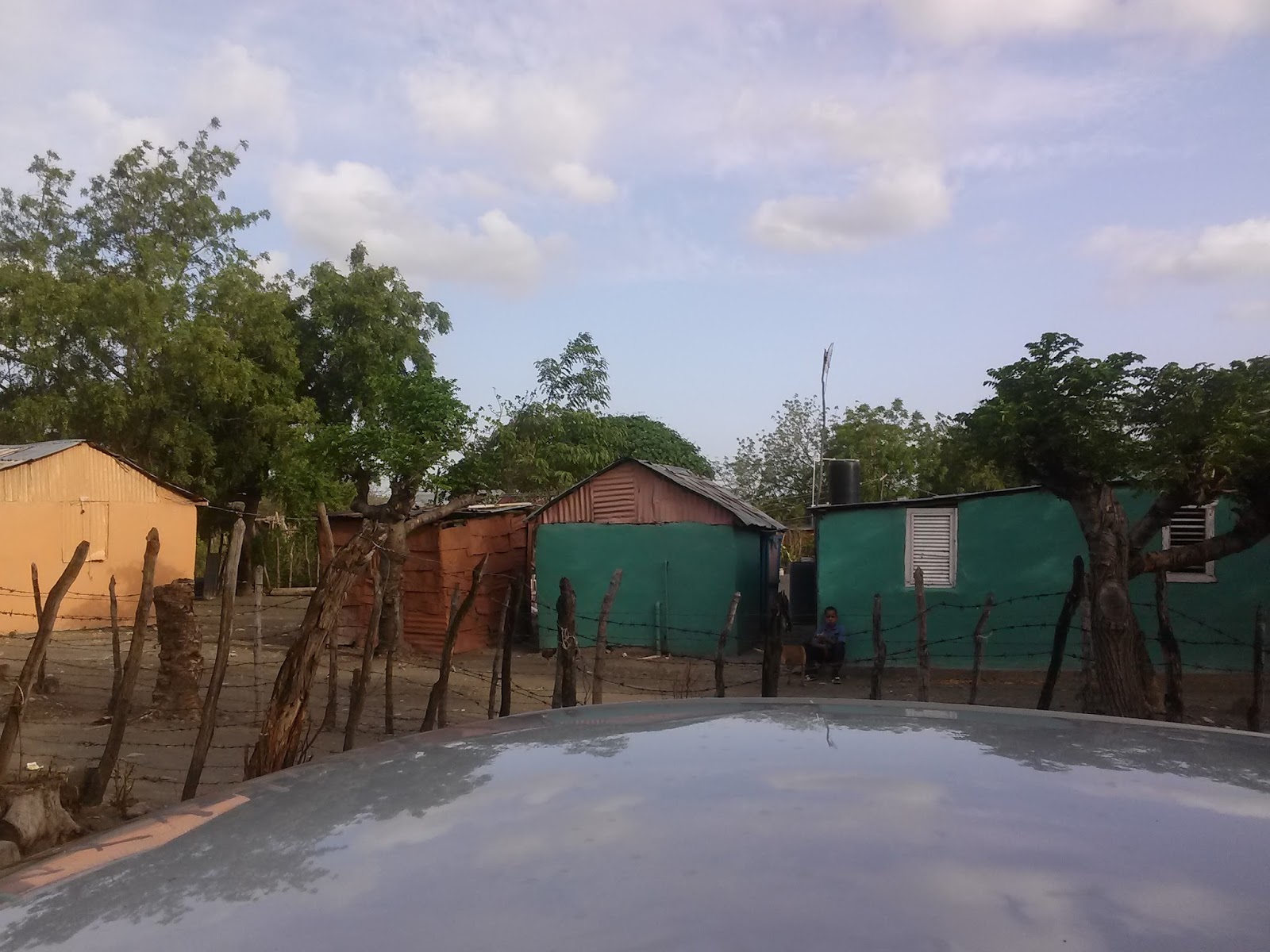
After taking the three samples, I then drove about 10 km northwest of Baní to a rural urbanization called Arroyo La Angostura. I had to ask the people at least three times for the name, since it was difficult to memorize. I had not heard of this place before. As I drove away from the city of Baní, the scenery changed. It seemed as if I were in a desert. The terrain was arid, and the background was mountainous. I noticed that once upon a time, there were many riverbeds that are now dried up. In fact, there was no rain this May season.
Finally, I interviewed Mrs. Rivera Lara. She had a recent lung operation. I was not sure if I should interview her or not. To my surprise, she consented to the interview despite her condition. I soon found out that Mrs. Rivera Lara was the daughter of two 1st-generation cousins. Her knowledge of family traditions were very clear in her mind. Unfortunately, she apologized for having forgotten the names of her grandparents. When I asked her why her family washed their hands upon leaving the cemetery, she said, because it was bad not to do so. She also added that even though she learned not to eat outside of her home, she would do it because of the extreme poverty. She was very honest. What startled me a bit was that her family killed the chicken by striking it with a stick on its back.So far, I have discovered three ways that people kill chicken: striking the back with a stick or with one's hands, twisting the neck, or slicing the neck with a sharp knife.
I woke up early this morning to meet Padre Germán at the Parroquia de Santa Cruz. I had been trying to reach him for the past 2 weeks, without success. I finally met him. When I reached the door, I shouted, "hello!" Suddenly a tall Haitian man said, "yes! Come in!" He then pointed to his left where the priest was sitting. Apparently he was the security. Padre Germán stood up and greeted me with warmth and a smile. He was dressed with a white shirt and with his preaching bands. He then asked me, "how can I help you?" I introduced myself and my project. He then started telling me about key people in Baní that could help me. He mentioned a Dagoberto Tejada, who is a fountain of knowledge on the Banilejos and has an office at the Centro cultural. He also mentioned Alexis Agramonte, who gave a speech last night about the history of the Banilejos. Finally, he also mentioned that I should speak with Mr. Manuel Valera. I told him that I already had spoken with him. He then told me that Baní is a special city because it is the third most important city of the Dominican Republic. He was proud to mention that the colonialists that founded Baní bought the lands, and that the inhabitants of Baní are a product of that truth. At this point, I was not sure that he was going to give me access and entry to obtaining 10 more women to interview from his community. He then added, "what can I do for you?" I told him that I needed a formal presentation before his community after a mass, in order to acquire 10 more women to interview. He agreed to do this introduction this upcoming Sunday at 8:30 am. He told me to arrive earlier so that he would know exactly what he is going to say. Padre Germán was happy that I am performing this kind of research. He said, "excelente trabajo!" Then I thanked him for his help and went my way, as he blessed me for the day.
Next, I met Mrs. Lara Díaz, who happens to be the secretary of Dra. Pimentel Mejía. After explaining what the investigation entailed, she agreed to participate and signed the consent form. She then noticed that it was in English and said, "how am I to understand this?" I assured her that everything that I explained was perfectly translated. Now I know for the next time that I will have to translate the consent forms. So, we began with the genealogy. She knew up to her great-grandmother. She made a quick phone call to confirm more of her grandparents. I began asking the usual questions about marriage arrangements in the family; she did not express anything out of the ordinary. Her family is interesting in that they were nominal Catholics and years later, some of them became evangelical Christians. I noticed that she did not have knowledge of many customs of her family. This has to be due to her age (34). I infer that there is a generation gap of knowledge between those that are younger than 50 years old. The younger generation has lost awareness of superstitions and traditions. However, Mrs. Lara Díaz did have knowledge of the weekend preparations in her family. She added that she still keeps this tradition. Her family accustoms to clean the house every Friday and wears the best clothing for Saturday and Sunday. She did mention that her mother would not cook on Saturday, but that she would buy the food. I had a particular interest of the ethical behavior of the family and especially the custom of the men wearing hats the entire time. She also added that the women would cover their hair with scarves. When I asked her if she knew about the Inquisition or having Jewish ancestry, she denied having that knowledge, but heard that there were Spanish ancestors along the maternal lineage. After the interview, she was curious about my questions. I shared some of the meanings and origins of the superstitions. She was amazed that these practices could be so old. She wondered if I was religious. When I told her that I was a Jew, she was amazed and I showed her my kippá (under my hat). She then proceeded to ask me a plethora of questions. I told her that it would take me at least a month to explain our tradition and way of life. She did not even know what or who are Jews.
The next interview was with Mrs. Gonzalez. When I called her, a girl answered and said, "Papiiiiii." I said, "this is not your daddy!" Her mother quickly took the phone and asked me where I was. I told her that I would arrive shortly. I was a bit uncomfortable to interview her at the Church setting. I was 15 minutes late to the interview. She told me that she almost left. I did not ask, but she seemed to be no more than 30 years old. As I started asking questions, I quickly realized that she did not have a vast knowledge of family traditions. The clearest traditions that she remembered were the dietary customs and the superstitions. I videotaped her 3 times and she laughed throughout the interview. She expressed to me that the times have changed from her grandparent's time until today. In fact, shed mentioned that men take women without the parent's consent and do not marry in the Church anymore. Finally, she said that her family was not too religious. They were not really church goers, until her mother started attending the Catholic Church and she tagged along (3 years ago). She scored the lowest out of the 78 questions that I ask.
Finally, I interviewed Mrs. Pimentel Lara. She is also from Villa Sombrero, but met me at the city center of Baní at the Casino. She was kind of in a rush. I assured her that the interview would be short. We started rapidly and she answered all of my questions. She had a very clear notion of family traditions. I was surprised to learn that divorced women in her family are not allowed to remarry. She also made a statement that "thank God, there are no cousins married with each other in the family." When I asked her about family purity and menstruation, she had no idea about this because it was a taboo to speak about it. However, she did give clear instructions about the "riesgo" 41-day period after childbirth. She was meticulous about this, explaining the scientific reasoning behind it. I smiled! She added that her mother says that there are crazy women out there because they no longer keep this tradition. Her family did have a sense of making the weekend special with food, clothing, and cleaning. She explained that they killed their chicken by twisting the neck. They did check eggs for blood spots and clean their rice 3 times before cooking it. She said that her family was very religious, attending as many services as possible. Just as all of the interviews thus far, her family demonstrated a high level of morals and ethics. It was interesting to learn that the men in her family wore/wear hats all of the time, and the women cover their heads at all times. Finally, she demonstrated a clear knowledge of the superstitions that crypto-Jews practiced throughout the Inquisition time period. When I asked her about the Inquisition, she said that she had heard about it, but was not sure what is was. She also denied having Jewish ancestry.
Until next time. Stay tuned...
Today I interviewed three women, namely, Mrs. Ysabel García, Ms. Roa Peña (Ruiz), who wishes to remain unidentified, and Mrs. Altagracia Rojas Lara.
I got lost as I searched for Mrs. García's home. I went south on Mella St, instead of north. Luckily, everything is within walking distance. She was very warm and receptive to the questions. When I explained why I was doing this investigation, she did not present any curiosity or rejection. I was able to confirm the practice of endogamous marriages in her family, in addition to other interesting traditions. Her family was not particularly superstitious. However, there is a strong indication of Jewish ancestry in her family. When asking the final questions about the Inquisition and having possible Jewish ancestors, she denied having that knowledge. After tabulating her customs/traditions in my chart, she scored 59/78. That is more than half of what I was looking for. I can't wait for the DNA results. They will determine whether a mother with Iberian or Levantine DNA transmitted those customs or if a male taught them to a spouse.
The second interview with Ms. Roa Peña began with a rough introduction. She is a lawyer that studied at the UASD university. When I gave her the consent form, I told her that I would translate it to Spanish. She insisted on reading it herself. Initially, she did not want to be recorded, videotaped, nor tested for DNA. I told her that she could not participate. I was ready to withdraw her as a candidate. Then she added that if there were some type of benefit, she would agree to participate, but without identifying her name or taking pictures/video. She presented an interest in acquiring a foreign passport. When I told her about the law of return of the Sephardic Jews, she knew exactly what I was talking about. She said, "¡Ahora m'estás hablando!" (Now you're talking)! She did not want to admit that she was looking for an exit, but I got it out of her. She then agreed to participate fully, but without video recordings. She wanted proof of participation. Therefore, I took a picture of the consent form and handed it to her. After interviewing her, she scored 65 out of 78. I was amazed that she even knew about the Inquisition and the Jewish ancestry of the Banilejos. I did not want her knowledge of me being a Jew to pollute the interview. Interestingly, the questions that I asked were not direct questions about Jewish identity, albeit, traditions that crypto Jews practice, with or without knowledge of Jewish ancestry. I hope to demonstrate the correlation between those customs and her DNA. When I told asked her if she had heard of the family being Jewish, she denied it, and added that she preferred being a Catholic.
The final interview for the day was with Mrs. Rojas Lara. She was reluctant to being recorded and taking the DNA sample. After explaining why I needed it and what I was looking for (without saying mentioning Jewish ancestry), she accepted the terms. She was not sure of signing the consent form, since it is written in English. I told her that would translate everything and that nothing therein would compromise her identity nor her rights. She was weary of being arrested for signing the wrong documentation. She added that she only trusts me because the priest presented me at the church last Saturday night. The interview was very smooth. I was able to get through the 70 questions in less than 40 minutes. I was difficult to hear because of the loud music in the background. We met at a prayer house, where the women were gathered. I saw Ms. Roa Peña there, and another woman that I will be interviewing. At the same time, another woman whose maternal great-grandmother was surnamed "Sanchez" demonstrated interest in participating. After interviewing Mrs. Rojas Lara, I discovered that she descended from the Gonzalez, Rojas, Lara, Mejía, and Sanchez families. After tabulating the results of the interview, I realized that she scored 68 out of 78. At this point, I can infer that the more founding families that the subject has in her genealogy, the more of these customs are prevalent. When I asked her about the Inquisition and about having Jewish ancestry, she denied having that knowledge. She did say that her grandmother taught her to respect the commandments, when I asked about her view of the "Law of Moses."
Tomorrow I will return to Santo Domingo in the evening. I plan on interviewing 4 to 5 women, if time allows.
To be continued...
I decided to to visit one of the local butcher shops in town and perhaps video tape how the fowl is slaughtered. I was three hours too late for the day. When I told the owner (Ariel) that I wanted to observe how he slaughtered the chicken, a lady next to me said in mockery and surprise, "oye ahora!" (check this out!). She thought that I was being rude or something by asking how the fowl was killed. I then approached the owner and told him that I was an anthropologist from the USA and was studying the customs and traditions of Bani, and that it was important for me to video tape the process of slaughtering. He then invited me to return early in the morning. I seized the opportunity to ask him how the chicken was slaughtered. He said, "we slice the neck." I then asked him which family he was from. He said, "Ortiz." I continued, "Ortiz what?" He replied, "Ortiz Andújar." Andújar is not on my list of surnames, but Ortiz is. He added that many students came to him investigating the same thing. Then he gave me directions on how to get to the Mercado, where I could probably catch people in the slaughtering process.
I followed his instructions and ran into a very busy street with shops and food establishments. I noticed the butcher shop "El Rincón del Pollo" and another one across the street, two shops away. After having identified myself as an investigator from the USA, I decided to ask the owner of the other shop if I could video tape them in the slaughtering process. He told me to come back tomorrow between 7-8 am. I quickly asked him how he slaughtered the chicken. He said, "I cut under the neck with a knife."Next, I approached "El Rincón del Pollo" butcher shop and saw a young kid packing the chicken for the customers. I quickly asked him, "how do you guys kill the chicken here?" He made the slicing-of-the-neck hand gesture. I thanked him and left.
After asking random people about this custom of slaughtering in Baní, I can conclude that the majority of the fowl sold here is slaughtered through the slicing of the neck and that people prefer buying their meat there.
Stay tuned...
This evening I was invited by Father "Felo," as he is called by his parishioners. As I walked into the cathedral, I heard the women saying the "Ave María" prayer. They repeated it many times. I felt lost, as I looked for Father "Felo." At last, I saw him and he recognized me. He called me to the front and introduced me to Mrs. Soto. I told her who I was and what I needed. She then promised to help me at the end of the service. I asked the priest how long the service would be. He said about one hour and a half. I then told him that I would come back. He asked, "why are you going to do that? Are you impious or something?" I said, "no, it's fine! I will sit during the mass." He added that I would be seen by the congregation by sitting through the mass. Indeed, he knew what he was talking about.
As the clergy entered the building, there was a band playing very rhythmic music upstairs. The music was based with a meringue rhythm. I could hear a guitar, drums, tambora (double-sided drum), and piano. There were two female vocalists. Once the clergy arrived at the altar, the priest carried incense in various directions. This reminded me of the Aharonic priests and the use of incense in the Temple. Then the priest said a prayer of confession. This is similar to the prayer said by the hazzan (cantor) on Kippur. The mass followed a sequence: a reading selection, music, then prayer. As I sat through the mass, I noticed how similar it was to the Jewish liturgy. It had dawned on me that a Jew could feel somewhat comfortable by listening to the words from the Torah and the Prophets. In fact, I was amazed that the selected readings for the Pentecost vigil came from Shemoth (Exodus) 19-20 and Yehezkel (Ezekiel) 37. These are the portions that Jews read for the Shahrith service of Shabu'oth (Feast of Weeks). I realized that a converso could easily assimilate to a nominal Catholic lifestyle, without leaving his/her Jewish customs at home. I also understood why some of them were so blatantly against the Catholic doctrine, when presented before an Inquisition tribunal. The priest said a prayer that mentioned that the Church is the "New Israel." I can see why a converso would feel irritable by Christian theology.
At the end of the service, the priest called me to the front and presented me to the congregation. He told them what I came to do and what I needed. I then read the list of 36 surnames, of the founders of Baní. I explained that I needed 30 women to interview and that I would be standing at the entrance of the church in order to hand out a quick survey. I then went to the entrance and waited for the people to approach me. As people exited the building, I waited about 1 minute, until a plethora of women, and some men approached me. The survey and pens left my hands as if I were giving away money. Some people wanted to participate, but did not hear their surnames. I thanked them for their interest. I had to repeat myself about 7 times as to why I was doing this research. Everyone seemed to be interested. I experienced the "impulse factor," a business strategy used to attract buyers. As one woman approached, two came behind her. I noticed that some of them did not want to be left out, so they reached out for a survey. One woman asked me if there was an inheritance left behind by her family. I said, there is an inheritance, but not exactly monetary. When I collected all of the pre-screening surveys, I noticed that I had less pens than what I started out with. I knew that would happen.
Finally, I had 18 women that filled out my pre-screening survey. This survey has four simple questions:
Are your maternal ancestors from Spain?
Do you have at least 3 generations in Baní?
Do you have at least 2 of the surnames on the list?
Are there cousins married in your family?
This survey allows me to choose who I want to interview and who will be selected for the DNA saliva test. I only have 30 kits, therefore, I must be very selective, since I want the DNA of the founding mothers of this town. When I analyzed the surveys, I counted 12 out of 18 that fulfill all of the criteria. I will select 5 from the other 6 as the control group, to compare their DNA with those of the 12. I am interested in finding out through the interviews if there will be a correlation between Iberian/Levantine DNA and the prevalence of Jewish customs along the maternal line.
Tomorrow I will go back to the Santa Cruz Church to do the same screening.
To be continued...
After having not received Mr. Valera's phone call, I decided to take a stroll to his home. I saw some men unloading merchandise from his house, and when we made eye contact, it was as if we had known each other. He received me into his home and we began talking. He told me, "Dígame a ver m'ijo, ¿En qué te puedo ayudar"? (Tell me son, how can I help you?) I told him that I would like to thank him first for his wonderful book of genealogy. He humbly looked downwards and accepted my praise. I told him that thanks to his work, I can now do my work. He added that Baní is the only town with such explicit records in the entire country. I was amazed at the wealth of knowledge that he demonstrated in the 20 minutes that we talked. When I told him that I was an anthropologist, he drew closer to me and said, "I can tell you many things that I cannot speak of with people from here." When I told him that I was looking for the Jews/conversos, he began telling me his genealogy. I was amazed that he knew his entire genealogy by heart, going back to Andujar, Jaén, Spain. He is a descendant of Rodrigo Sanchez de Segovia, one of the Jews that saild with Cristobal Colón to Hispaniola. I told him that the Dominican people have many customs that they do without knowing their origin. He agreed with me completely. He spoke of some aristocratic Dominican families and their origins, without necessarily stating that they were Jews. He understood it as such due to his genealogical investigations. Furthermore, Mr. Valera made genealogical connections with people, linking them back to Spain. When he asked me if I had family from Baní, I told him, "yes!" He asked, "which families?" I answered, "Araújo y Lara." He immediately said, "Oh the Araújo are Portuguese." He also told me that he descended from the Lara family and explained the entire genealogy. He added that his grandmother would always speak about the Lara's. At that moment I was convinced that he knew exactly what he was talking about. Unfortunately, it seemed that he was in a rush and had to attend his daughters that came to visit for the weekend. At that moment, he told me that he had called twice, without avail. Following, he invited me to come back and call him first. I realized that I didn't have his number and neither could I ask him, since I knew that he would write it down and then hand me a paper with it. Since it was Shabbath, I neither wanted him to write it down, nor was I in a position of carrying anything in the public domain. I guess that I will have to go back by surprise.
I went to the Maria de Regla Catedral and spoke to Padre Felo. He received me with warmth and demonstrated interest in my research. He invited me for Pentecost this Saturday night to introduce me to the congregation. He told me to arrive at 6pm in order to introduce me one-by-one to the people that he thinks would be willing to participate. He gave me a huge lead by telling me that I should visit the town historian, Manuel Valera. Mr Valera wrote a genealogical book on the families of Baní called, Familias Banilejas. Padre Felo told me that Mr. Valera frequents the Church archives on a weekly basis. He also told me that I would be able to identify his house because of the Spanish Crest of his family. He jokingly said, "He considers himself Spanish because of his origins."
I walked about 10 minutes north to the Santa Cruz church, hoping to find the priest in order to gain access and entry. The two Haitian workers there told me that he had just left and would return around midday. I then walked back south in order to look for Mr. Valera's home. I walked around observing the architecture and the names of the businesses. As I walked through the streets of Baní, I felt that I was walking in the streets of Galicia, or perhaps Barcelona. This city has a colonial Iberian feel to it.
I noticed that the majority of the older men wear some kind of headcovering, either a cap or a fedora. I observed that they even use it inside their homes or businesses and wondered why they would do such a thing with the extreme desert-like climate of Baní. That is something that I will look into.
After walking for about 15 minutues, lost, I finally arrived at Mr. Valera's home. I recognized the Spanish crest of the Valera family on his wall. His house looks like an Iberian-styled museum from the outside. I knocked on all of the doors and at last, a woman answered. I presented myself and she allowed me to entered after I presented myself. I approached the living room and spoke to Mrs. Valera. She looked young. I had imagined Mr. Valera to be an elderly man. I told her who I was and what I was looking for in Baní. She told me that her husband was not home and that I would have to return. I left her a poster with my local contact. I then asked her how old was her husband, since she appeared to be in her late 30's perhaps. She smiled and invited me to another room where she had family pictures. They have two daughters, apparently in their 20's. Mr. Valera is perhaps in his late 40's or early 50's, by the looks of it.
I asked Mrs. Valera what family she was from. She said, "Medina," and added, "perhaps we are family too, since everyone here is related somehow."
At this point, I have to go back to the capital to get more clothes, where I have the rest of my luggage, since I didn't expect to stay in Baní for so many days. Either way, I must come back early tomorrow to prepare for Shabbath and Shabu'oth. So, I will be celebrating Pentecost with the Catholic community of the Maria de Regla Cathedral.
Talk about covert research...
Discovering the Hidden Roots of the Banilejos
I visited two churches: Parroquia de Santa Cruz and Parroquia Nuestra Madre de Regla. At the former, I spoke to Mr. Guerrero Arias (c. 65), who has been in the Church service at as assistant to the priest since his first communion. When I asked him about cousins marrying each other, he said, "Los primos se primen". Any Dominican from the rural parts of the country knows what that means. In sociological lingo, that implies endogamy. I asked him what families were known for this practice, he said, the Arias and the Zapata. He added that the Zapata family in particular is keen about keeping it in the family, lest they mix with "strangers".
Discovering the Hidden Roots of the Banilejos
So I went on another moped to Villa Sombrero, about 5km west of Bani. I went to the local Catholic Church to get access and entry. There was a huge sign at the office stating, "Office Hours, Tuesday, Wednesday, and Friday, 3pm-6pm, Note: We do not work outside of those hours." Next to that sign, there was another one stating, "We absolutely do not process any documentation here related to cases of judicial nature." As I waited for the priest to arrive, I quickly asked probing questions to find out about her own family and the local customs.
Hemos abierto un nuevo canal e iniciamos el estudio de la Introducción al libro de Tehilim (Salmos) siguiendo el comentario de Hakham Dawid Kimhí (Radaq)
¡Suscríbete y no pierdas de vista ninguna de las clases!
En la descripción de un viajero francés del año 1795, encontramos testimonio de las persecuciones contra los judíos en dicha época:
“en Santo Domingo hay muchos judíos… durante la procesión, las mujeres y los niños sostienen muñecas que representan judíos y ellas son colgadas de los tranvías y en las plazas. Los soldados les disparan y a veces asaltan y se destruyen casas judías. El año pasado, fueron asesinados tres de ellos”
(Extraído del libro Bnei Ahuma Aiehudit Beezor Hakaribi, Mordekhai Arbel, pag 247).
Actualmente el Centro de Estudios Sefaradies de la República Dominicana, a través de su director, R'Elazar-DeMota, está conduciendo una investigación sociológica/antropológica sobre los descendientes de estos judíos de origen hispano-portugues. Si estas interesado en ser parte de esta investigación escribe a haham@nidheisraelrepdom.org